
The rupee on Monday plunged by 48 paise to hit its life-time low of Rs 57.54 in early trade on heavy dollar demand and the US currency strengthening against major rivals overseas.
If the administrative/regulatory/judicial logjam can be loosened, there could be a quick yield in higher output, which would have multiplier constraint-loosening effects on the economy as well as lead to higher savings, a critical prerequisite for reducing the domestic savings-gap and thus help reduced the unsustainably high CAD.

The majority view remains for the central bank to leave the cash reserve ratio unchanged at 4 per cent.
Delay in the tapering of the $85 billion-a-month bond buyback programme by the US Fed (tapering will start from January 1) gave the country time to replenish the forex reserves and rein in the high current account gap.
Despite a high current account deficit (CAD) and lower interest rates abroad, the Union government will not go for a sovereign bond issue to get more dollars.

With India faced with high Current Account Deficit, FM has been visiting major global financial hubs like Japan, Germany, Hong Kong and Singapore, to project the country as a investment destination.

RBI is scheduled to announce the monetary policy for the current financial year on May 3 during which it will take a call on interest rates keeping in view the inflation and other macro-economic parameters like growth rate, industrial production etc.

Looks at sovereign funds and Fortune 500 firms.

On the Budget day, when the Finance Minister reads through reams of paper, the common man is often left confused. Worse still, there are a whole lot of numbers and jargons like capital account expenditure and current account deficit that could baffle many.
RBI Governor Rajan on Wednesday said significant progress made in curbing current account deficit.

The Reserve Bank too imposed a series of curbs to restrict gold imports.
The Budget tried to please politicians, rating agencies and reformists, and let them all down -- slightly.

The ballooning of crude prices has significantly increased the country's oil import bill and it can also lead to a worsening of the current account deficit and fiscal deficit for the domestic economy.
India's balance of payments for the first quarter of this fiscal showed a three-fold increase in deficit in trade balance at $15.8 billion against $5.1 billion in the same period last fiscal.

RBI's 50-bps cut can be construed as the central bank tactically using this narrow window of opportunity -- when inflation has gapped down -- to frontload the rate cuts intended for the year, knowing opportunities may not come by later.

Making a case for raising prices of diesel, kerosene and LPG, the Reserve Bank on Tuesday said hike in rates of petroleum products is necessary to arrest fiscal slippages.

Chidambaram said banks have been asked to strictly adhere to the norms on gold imports.

The finance ministry is considering raising import duty on gold by two percentage points to six per cent, as the surge in demand for the yellow metal threatens to further widen India's current account deficit.
RBI has sent letters to the country's richest temples asking for details of their gold.
Amid rupee sliding below 64 to a dollar, global agency Standard & Poor's on Tuesday said it will maintain negative outlook for the country as currency depreciation is adversely impacting investor confidence.

The CAD, which represents the difference between exports and imports after considering cash remittances and payment, widened to a record high of 5.4 per cent of gross domestic product, or $22.3 billion, in the July-September quarter.

Importing gold widens current account deficit, channels domestic savings into personal investments and of course forces domestic entrepreneurs to scout for foreign funds, writes M R Venkatesh.
Amid all the gloom on the economic and financial front, Sandesh Kirkire, CEO, Kotak MF, suggests five bold measures to get the Indian economy back on the growth path, arrest the rupee's downfall and address India's bulging current account deficit.
When the outflows are more than the inflows, a deficit occurs in the current account of the nation, which is widely known as the Current Account Deficit.

Multiple concerns have, of late, raised questions about India's continuing growth story. Persisting high inflation threatened a hard landing for India's economy, says Shikha Sharma.
A heavy dependence on imported energy, gold and technology means India has historically run a current account deficit, which it has funded by attracting foreign money into stocks, bonds and corporate investment.
A rapidly deteriorating balance of payments may warrant that but the political climate is too risky
RBI has permitted Axis Bank, Kotak Mahindra Bank, IndusInd Bank and Yes Bank to import gold.

Amid fast-depleting forex reserves, the Finance Ministry on Wednesday signalled that it was not in favour of selling the dollar to defend any particular level of the rupee. "Let it (rupee) reach whatever levels it has to reach. We can't fritter away reserves on defending some artificial, imaginary rate of exchange," a senior finance ministry official told Business Standard. Forex reserves declined to a near two-year low of $545.65 billion as on September 16, down $85.88 billion from the level that existed on February 25, a day after Russia invaded Ukraine.
The Vijay Kelkar committee has cautioned that India's current account deficit (CAD) might rise to a record 4.3 per cent of gross domestic product (GDP) in 2012-13 if reforms to address this do not take place.

Encouraged by foreign exchange reserves touching record levels, the Reserve Bank on Tuesday doubled the annual overseas investment ceiling for individuals to $2,50,000.
Lower imports has helped narrow trade deficit to $9.92 billion in January from $18.7 billion.

India appears poised to sustain its growth in a more durable way than before with the economy carrying the momentum from FY23 into the current fiscal year, the Annual Economic Review for 2022-23 released by the finance ministry on Thursday said. However, the report cautioned that escalation of geopolitical stress, enhanced volatility in global financial systems, sharp price correction in global stock markets, a high magnitude of El-Nino impact, and modest trade activity and FDI inflows, are factors that could constrain the pace of growth. "Should these developments deepen and dampen growth in the subsequent quarters, the external sector may challenge India's growth outlook for FY24," the finance ministry said.
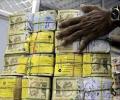
The fall would have been much more pronounced, had there not been sustained capital inflows worth of over $100 million in equities, forex dealers said.

India's Current Account Deficit rose to a record 6.7 per cent in the quarter ended December of 2012-13.

Focus should be on integrating India into regional trade blocs and helping professional services transcend borders.

Giving more freedom to individuals travelling abroad, they may soon be allowed to spend $2 lakh overseas in a year as against the present ceiling of $75,000.

Earlier, finance ministry officials had said sovereign bonds could address the financing problems of the CAD and the infrastructure sector.
The central bank also asserted that the country is ready for the tapering of the US Federal Reserve's bond purchases.
 © 2026 Rediff.com - Advertise with us - Disclaimer - Privacy Policy - Sitemap - Feedback - About us - Terms of use - Grievances